Do Skin Supplements Actually Work? An Evidence-Based Guide to Looking Less Tired
TL;DR
Yes — certain skin supplements genuinely work, but they aren't miracles and can't replace sunscreen, sleep and a nutrient-dense diet. Strong evidence sits behind hydrolysed collagen peptides and vitamin C, which support skin elasticity, hydration and collagen synthesis from within. Much of the wider "beauty supplement" market relies on under-dosed blends or ingredients with little benefit unless you have a clinical deficiency. Choose on clinical dosing and proven bioavailability, not marketing.
If you wander down the beauty aisle of any health store, you'll be met with a dizzying array of gummies, powders and capsules promising to "erase wrinkles," "restore youth," and banish the signs of fatigue. For the discerning consumer, this chorus of marketing claims often triggers a healthy dose of scepticism. It begs a straightforward question: do skin supplements actually work, or are you just paying for expensive, cleverly packaged vitamins?
As a science-led brand, Youth & Earth believes that navigating the health and beauty space shouldn't require a degree in biochemistry, nor should it rely on blind faith. You deserve honest, evidence-graded answers.
This guide strips away the hype to examine what the clinical research genuinely says about supplements for both skin and appearance. It also seeks to answer why your skin changes as you age and the specific ingredients that may move the needle, and how cellular energy plays a surprising role in why you may "look tired."
Do skin supplements actually work?
The honest answer sits between the two extremes you'll usually hear. It isn't all hype, and it isn't magic either. A small number of ingredients — hydrolysed collagen peptides and vitamin C chief among them — have genuine human clinical evidence behind them. [1] The rest of the category is far less convincing, with proprietary blends that hide their dosing, biotin being sold as a skin-and-hair "cure-all" despite only helping people with a diagnosed deficiency, and "tired-look" formulas that lean on plausible-sounding biology rather than trial data.
The distinction that matters, then, isn't "supplements vs no supplements" — it's evidence vs assumption. Once you know which ingredients have earned their claims, the rest of the decision becomes a question of dose and quality, which we cover in section 6.
Why skin and the "looking tired" appearance change with age
To understand how supplements might help, it helps to understand what's happening beneath the surface of the skin as we age.
Skin isn't merely a static wrapper — it's a highly active, metabolically demanding organ. Its firmness and bounce are maintained by a structural matrix in the dermis (the deeper layer of skin), made up of collagen, elastin and hyaluronic acid.
From our mid-twenties onwards, a biological shift takes place:
- The collagen deficit — natural collagen production begins to decline at a rate of around 1% per year, while the existing collagen matrix slowly degrades due to natural ageing. External factors like UV exposure and pollution can also play a role, ramping up oxidative stress and increasing inflammation.
- Loss of hydration — the skin's ability to produce and retain hyaluronic acid diminishes, leading to a loss of plumpness and a duller complexion.
- Slower cellular turnover — the rate at which skin sheds dead cells and replaces them with fresh ones slows down, contributing to a lacklustre appearance.
Why do we "look tired"?
Interestingly, "looking tired" isn't always a direct reflection of fine lines — it's also heavily influenced by internal factors. When you're genuinely fatigued, your body redirects blood flow away from the skin toward vital organs, resulting in a paler, duller complexion that makes dark circles more prominent. A loss of facial muscle tone and cellular function can add to a drawn, heavy appearance.
Addressing the "tired" look, therefore, tends to need a two-pronged approach: supporting the skin's structural matrix directly, and supporting the body's overall cellular energy.
The evidence-graded supplement list
Not all supplements are created equal. When evaluating products for appearance, look for human clinical trials showing measurable improvement — not just a possible mechanism. Here's an honest grading of the ingredients most often marketed for skin and appearance.
| Ingredient | Primary benefit | Evidence strength | What you need to know |
|---|---|---|---|
| Collagen peptides | Skin elasticity & hydration | Strong | Must be hydrolysed into small peptides for absorption. Best evidence is for Type 1 and 3 at doses of 5g–10g daily. |
| Vitamin C | Collagen synthesis & antioxidant | Strong | Essential support for the enzymes that build collagen; protects against oxidative stress. Both topical and oral forms are evidence-backed. |
| Omega-3 fatty acids | Skin barrier & inflammation | Strong | Helps maintain the skin's barrier, supporting moisture retention and managing inflammatory skin conditions. |
| NMN / NAD+ precursors | Cellular energy & vitality | Emerging | Primarily studied for cellular energy and healthy ageing; the effect may help address the physical appearance of fatigue. |
| Hyaluronic acid (oral) | Skin hydration | Moderate–emerging | Traditionally used topically, but recent studies suggest oral supplementation may help support overall skin moisture. |
| High-dose biotin | Hair & nail growth | Weak / hype | Popular in marketing, but evidence shows visible benefit only if you have a clinical biotin deficiency, which is rare. |
| Proprietary "beauty blends" | Varies widely | Weak / marketing | Brands often group many ingredients together without disclosing exact doses — meaning you likely aren't getting a clinically effective amount of anything. |
Collagen for skin: what the research shows
Collagen is one of the most heavily debated skin supplements, but over the last decade the clinical evidence has matured significantly.
The early scepticism around collagen was based on a simple biological premise: if you eat a whole collagen molecule — like chewing on a piece of gristle — your digestive system would break it down into individual amino acids, just as it would with a chicken breast. It doesn't travel directly to your face to fill in wrinkles.
Modern supplement science solved this with hydrolysis. High-quality supplements use hydrolysed collagen peptides — collagen proteins broken down enzymatically into tiny chains of amino acids.
Robust, double-blind, placebo-controlled human trials have shown that these specific peptides can survive digestion and cross the intestinal barrier intact. Once in the bloodstream, they do two things: they supply the amino acid building blocks — glycine, proline and hydroxyproline — needed to build new collagen, and, more importantly, they act as signalling molecules. When they reach the skin, they bind to receptors on fibroblasts (the cells that make collagen) and prompt them to ramp up production of new collagen, elastin and hyaluronic acid, as if the body had sensed existing collagen breaking down.
Studies consistently show that daily supplementation with 5 to 10 grams of high-quality hydrolysed marine collagen may support skin elasticity, improve hydration and reduce the appearance of fine lines over 8 to 12 weeks [2] — and preserving that elasticity matters just as much if you're going through a period of rapid weight loss, where skin and connective tissue come under similar strain. We cover that in more detail in our guide to collagen and GLP-1 support.
Energy, sleep and looking less tired (the overlooked factor)
While collagen supports the skin's structure, we can't ignore the internal side of "looking tired." No cream or skin vitamin can outwork chronic cellular exhaustion.
When cellular energy production is optimal, it shows up in your posture and your facial features. When you have an energy deficit, you look drawn and fatigued — which is where longevity science intersects with aesthetics.
The cellular energy angle
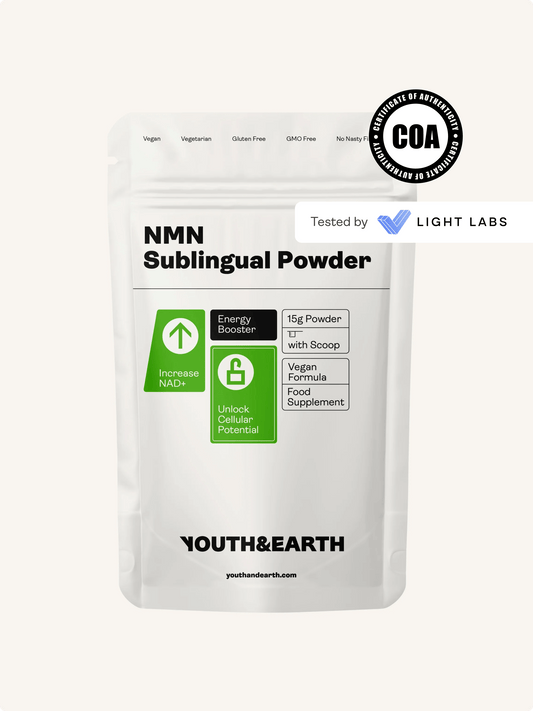
As we outline in our NMN & NAD+ Pillar Guide, a molecule called NAD+ is fundamental to how our cells produce energy (ATP). NAD+ levels naturally decline with age. By supporting these levels with precursors like NMN, you may help support cellular energy production across the body. NMN isn't a "skin supplement" as such, but many people report that supporting cellular energy levels helps them feel — and consequently look — more vibrant and less fatigued.
The role of muscle and vitality
Similarly, supplements that support physical energy and muscle function, such as creatine, play an indirect role in appearance. Maintaining healthy muscle tone — including facial muscles — and physical vitality changes how we carry ourselves. For a deeper dive, see our guide on creatine for women.
Ultimately, the best way to look less tired is to be less tired. Prioritising sleep hygiene, supporting your cellular energy pathways and addressing cellular fatigue matter just as much as supporting your skin directly.
How to choose skin supplements that aren't just marketing
If you decide to invest in an evidence-based routine to support your appearance, use these three rules to make sure you're buying science, not marketing:
Check the dosing — if a brand hides its collagen behind a "proprietary beauty blend," or offers a daily dose of just 500mg, it's unlikely to be effective. Clinical research for collagen generally uses 5g to 10g per day. Always check the label for the exact weight of the active ingredient.
Look for bioavailable forms — for collagen, the label should say "hydrolysed peptides." Type 1 and 3 collagen peptides are generally considered to be the gold standard for skin, thanks to their smaller particle size and their structure which is similar to that of human skin collagen.
Insist on third-party testing — the supplement industry is notoriously under-regulated. Reputable brands voluntarily submit their products to independent laboratories to verify purity, heavy-metal safety and active-ingredient content.
At Youth & Earth, we formulate our products based on human clinical data, not fleeting trends. If you're looking for a scientifically rigorous starting point for skin support, explore the Youth & Earth range, hydrolysed for maximum absorption and strictly third-party tested for purity.
Frequently Asked Questions
Do collagen supplements work for skin?
Yes — clinical evidence shows that high-quality, hydrolysed collagen peptides can effectively support skin elasticity, hydration and the appearance of fine lines. [3] The key is ensuring the collagen is hydrolysed (broken down into absorbable peptides) and taken at a clinically relevant dose, typically 5–10 grams daily.
What supplements help you look less tired?
Addressing the appearance of fatigue means tackling both skin structure and cellular energy production. Hydrolysed collagen and vitamin C support the skin's firmness and brightness. Supporting cellular energy through sleep, a healthy lifestyle, and potentially NAD+ precursors like NMN can help address the cellular causes of looking drawn and fatigued.
Is vitamin C good for skin?
Yes. Vitamin C is an essential co-factor in the body's natural collagen synthesis process, and it acts as a potent antioxidant, helping protect skin from oxidative stress caused by UV exposure and environmental pollutants. [4] Both topical serums and oral supplementation are beneficial.
Can supplements replace skincare?
No. Supplements work from the inside out, supporting the structural integrity of your skin and providing essential building blocks. Topical skincare — especially daily SPF to prevent UV damage, and moisturisers to protect the skin barrier — works from the outside in. They're complementary, not mutually exclusive.
How long until skin supplements work?
Skin cells take time to turn over, and new collagen takes time to synthesise. Most clinical trials measuring the effects of collagen peptides on skin elasticity and hydration observe significant results after 8 to 12 weeks of consistent, daily use. Patience and daily adherence matter more than any single dose.
Are skin supplements worth it?
They're worth it if you choose ingredients with strong human evidence — hydrolysed collagen, vitamin C and omega-3s — from transparent brands that provide effective doses. They're not worth it if you're buying under-dosed "beauty blends," generic biotin gummies without a diagnosed deficiency, or expecting a supplement to undo the effects of chronic sleep deprivation or a lack of sun protection.
DISCLAIMER
The information in this article is for educational purposes only and is not intended as medical advice. Please consult a qualified healthcare professional before starting any new supplement regimen, especially if you have an underlying medical condition or are pregnant.
References
[1] Myung SK, Park Y. Effects of collagen supplements on skin aging: a systematic review and meta-analysis of randomized controlled trials. Am J Med. 2025;138(9):1264-1277. DOI: https://doi.org/10.1016/j.amjmed.2025.04.034
[2] de Miranda RB, Weimer P, Rossi RC. Effects of hydrolyzed collagen supplementation on skin aging: a systematic review and meta-analysis. Int J Dermatol. 2021;60(12):1449-1461. DOI: https://doi.org/10.1111/ijd.15518
[3] Choi FD, Sung CT, Juhasz MLW, Mesinkovska NA. Oral collagen supplementation: a systematic review of dermatological applications. J Drugs Dermatol. 2019;18(1):9-16. https://pubmed.ncbi.nlm.nih.gov/30681787/
[4] Pullar JM, Carr AC, Vissers MCM. The roles of vitamin C in skin health. Nutrients. 2017;9(8):866. DOI: https://doi.org/10.3390/nu9080866