NMN and NAD+: What They Are, What the Evidence Shows, and How to Use Them
TL;DR
NAD+ is a coenzyme every cell relies on for energy and repair, and levels decline with age. NMN is a precursor your body converts into NAD+. Human trials confirm NMN safely raises NAD+ levels; evidence for specific benefits like energy and healthy ageing is promising but still emerging. Typical studied doses run 250mg–1,250mg daily.
Introduction
NMN and NAD+ come up constantly in conversations about healthy ageing, cellular energy and vitality — but the terminology is confusing, and the marketing around it often outpaces the science. This guide sets out plainly what each molecule is, what the human evidence currently shows, and how to think about NMN if you're building it into a longevity routine.
Key Takeaways
- What they are: NAD+ is a vital coenzyme found in every cell, essential for energy production and cellular maintenance. NMN is a precursor or building block that your body uses to create NAD+.
- Why they matter: NAD+ fuels every cell in the human body, however levels naturally decline with age. This decline has been linked to many of the hallmarks of the ageing process. Supporting NAD+ is a popular strategy in longevity science.
- The evidence: Most early research was on animals. Human studies are now emerging and show that NMN effectively increases NAD+ levels in the body — research is ongoing into what that means for specific health outcomes.
- Energy and fatigue: NAD+ is fundamental to mitochondrial function, the process that produces cellular energy (ATP). NMN may help support this process, though evidence for its direct effect on subjective fatigue is still early-stage.
- How to use it: Human studies typically use daily doses from 250mg to 1,250mg. Quality is paramount — always choose a provider offering third-party verification for purity and stability.
What Are NMN and NAD+?
Nicotinamide Adenine Dinucleotide (NAD+) is a critical coenzyme present in every living cell. It acts as a shuttle for electrons in cellular respiration — the process that converts food into energy — and is essential for the function of key proteins that regulate cellular health and repair, such as sirtuins and PARPs.
Nicotinamide Mononucleotide (NMN) is a direct precursor to NAD+. Think of it as a raw material your body can efficiently convert into the final, active NAD+ molecule. Supplementing with NMN is a strategy to provide the building blocks your body needs to maintain or boost its NAD+ levels.
Why NAD+ Matters — and Why It Declines With Age
To understand the interest in NMN, it helps to first appreciate how central NAD+ is. It's one of the most abundant and crucial molecules in the human body, second only to water in its prevalence, and every cell relies on it to function.
Cellular energy metabolism
NAD+ is indispensable for mitochondrial function. The organelles are often called the "powerhouses" of our cells because they generate adenosine triphosphate (ATP), the body's primary energy currency. NAD+ is a key player in the Krebs cycle and the electron transport chain — the two core processes that convert glucose and fatty acids from food into the ATP that fuels everything from muscle contractions to brain activity.
Cellular maintenance and repair
Beyond energy, NAD+ is used as a substrate by several families of enzymes that act as cellular guardians.
- Sirtuins: often called the "longevity genes," sirtuins are proteins that regulate cellular health, including DNA repair, inflammation and metabolic processes. They require NAD+ to function — when NAD+ levels are high, sirtuin activity is enhanced, supporting cellular resilience.
- PARPs (poly-ADP-ribose polymerases): these enzymes are the cell's first responders to DNA damage. When they detect a break in a DNA strand, they use NAD+ to build a long, repeating molecular chain (polymer chain) to signal the repair machinery — a process that consumes significant amounts of NAD+.
Our natural supply of NAD+ isn't constant. Numerous studies have documented a significant decline in NAD+ levels as we age — it's estimated that by middle age, the average person has about half the NAD+ levels they had in their youth.
This decline comes from a combination of reduced production and increased consumption. As we accumulate more cellular damage over time, enzymes like the PARPs become more active, consuming more NAD+. That creates a downward spiral: lower NAD+ impairs the cell's ability to produce energy and repair itself, which leads to further damage and an even greater demand for NAD+.
Another important contributor to NAD+'s decline is CD38, an enzyme found on the surface of many immune and other cells that breaks down NAD+. CD38 activity appears to increase with age, particularly as chronic low-grade inflammation and senescent, or 'zombie' cells accumulate. As a result, more NAD+ is consumed to support this increased enzymatic activity, further reducing the amount available for cellular energy production, DNA repair and other essential processes. This has made CD38 an important area of ageing research, particularly when looking at why NAD+ levels fall over time and how that decline might be slowed or reversed. Of note is that age-related NAD+ decline is now considered one of the key "hallmarks of ageing."
This is where precursors like NMN come in. The theory is that supplementing with a direct, efficient precursor can help counteract this age-related decline, giving the body the resources to synthesise more of this vital coenzyme. To learn more about how NMN compares to other NAD+ precursors, read our detailed guide on NMN vs NR vs Niacin.
What the Evidence Actually Shows (and Its Limits)
The journey of NMN from laboratory to supplement cabinet has been a rapid one, and it's worth evaluating the evidence with a clear, balanced perspective.
Preclinical evidence (animal studies)
The initial wave of excitement around NMN was driven by extensive research in animal models, primarily mice. These studies, many from the laboratory of Professor David Sinclair at Harvard Medical School and others, produced remarkable results, suggesting that raising NAD+ levels in older mice could support:
- Improved metabolic function, including insulin sensitivity
- Enhanced physical endurance and muscle function
- Cardiovascular and neurological health
These animal studies were foundational — they established the biological plausibility that raising NAD+ could have meaningful effects, and paved the way for human trials. But it's essential to remember that mice aren't humans, and results from animal studies don't always translate directly.
Human clinical trials
The crucial next step was testing NMN in humans. Over the last few years, a growing number of human clinical trials have been published, answering some key questions while opening up new ones.
What we know for sure:
- NMN raises NAD+ levels: multiple randomised controlled trials have now definitively shown that oral NMN supplementation effectively and safely increases NAD+ levels in human blood and tissue — confirming the precursor survives digestion and is successfully converted in the body.
- NMN is generally safe and well-tolerated: across these studies, using doses typically ranging from 250mg to 1,250mg per day, NMN has shown a strong safety profile with no significant adverse effects compared to placebo.
What the emerging evidence suggests:
With NMN's effect on NAD+ confirmed, research has turned to physiological outcomes. These studies are more recent and ongoing, but early data is encouraging:
- Physical performance: a 2021 study on amateur runners found that NMN supplementation improved aerobic capacity, suggesting better oxygen utilisation during exercise. Another study in older adults showed improvements in walking speed and grip strength. [1]
- Metabolic health: a key study in post-menopausal women with prediabetes found that NMN improved muscle insulin sensitivity — an important marker of metabolic health. [2]
- Overall well-being: some studies have used measures of biological age and general health questionnaires, noting improvements in these markers with NMN supplementation. [3]
The limits of the current evidence
It's important to be honest about the limitations here. The field is still young, and most human trials have been relatively small and short in duration — typically six to twelve weeks. The data on boosting NAD+ itself is robust, but the evidence for specific, long-term outcomes like improved energy or healthy ageing is still emerging. [4] Larger, longer-term studies are needed to understand the effects of sustained NMN supplementation across diverse populations.
NMN, Energy Levels and Fatigue: What the Evidence Shows
That evidence gap matters most here, because energy and fatigue are the benefits most people are looking for. The underlying logic is straightforward: NAD+ powers the mitochondrial process that generates ATP, so when levels are low, that energy production line can run less efficiently — which, at a whole-body level, may show up as tiredness.
By providing the raw material to boost NAD+, NMN may help support the efficiency of this process. The theory is that restoring NAD+ to more youthful levels supports mitochondrial function, leading to more efficient ATP generation and, in turn, better subjective energy.
What's harder to say with confidence is how directly that translates into someone genuinely feeling less fatigued day to day. Some clinical trial participants anecdotally report increased energy, and some studies show improved physical endurance — a useful proxy for energy utilisation — but few trials have been designed specifically to measure subjective fatigue as a primary outcome.
So while the mechanistic link is strong and early signs are positive, it's worth framing this cautiously: the idea that supporting NAD+ may help with energy and fatigue is a promising, logical hypothesis, but we're still waiting on robust clinical data that directly measures these subjective outcomes at scale.

How to Take NMN: Dose, Timing and Quality
If you're considering adding NMN to your routine, it's worth approaching it systematically.
Dose
Most human clinical trials have investigated NMN at doses from 250mg to 1,250mg per day. For most people starting out, 250mg to 500mg is a common entry point. The research suggests a dose-dependent effect — higher doses (up to 1,250mg) tend to produce a greater increase in NAD+ levels — so it's worth starting lower and seeing how your body responds before increasing.
Timing
There's no firm scientific consensus on the optimal time of day to take NMN. Many people prefer the morning, on the rationale that boosting NAD+ at the start of the day may support daytime energy and align with the body's natural circadian rhythm. It can be taken with or without food.
Quality
This is arguably the most important factor. The supplement market is unregulated, and NMN quality varies dramatically between brands — low-quality NMN may be unstable, contain impurities, or fall short of its stated dose. Always look for a provider that can demonstrate real commitment to quality. For more on this, read our guide on how we built a brand you can trust.
Building a Longevity Stack: What to Add to Creatine + NMN
For those already seeing benefits from foundational supplements like creatine and NMN, the next question is often, "what else should I consider?" Building a "stack" means thoughtfully adding compounds that may offer complementary benefits. Here are a few evidence-led options to consider adding to a creatine + NMN base.
| Supplement | Evidence Strength (Human Data) | What It May Add to Your Stack |
|---|---|---|
| Liposomal Spermidine | Moderate & growing | Supports autophagy — the body's cellular clean-up process that removes damaged components, complementing NMN's role in cellular repair and energy production. |
| Calcium AKG (CaAKG) | Early but promising | CaAKG is an important part of the Krebs cycle, which cells use to produce energy. It may also influence enzymes involved in gene regulation and DNA methylation, which is why it is being studied for healthy ageing. |
| TransResveratrol | Mixed (bioavailability issues) | Often paired with NMN because of its potential effects on sirtuins (longevity proteins involved in cellular stress responses). The theory is that NMN helps supply the NAD+ these enzymes need, while resveratrol may help stimulate their activity — although human evidence remains mixed. |
| Mitochondrial CoQ10 | Strong (for CoQ10 levels) | CoQ10 helps mitochondria turn the food we eat into usable cellular energy. Supplementing with CoQ10 may support this energy-production system alongside NAD+. |
A note on stacking
The goal behind a well developed stack is synergy, not just adding in more products — by supporting different but interconnected pathways. NMN supports NAD+ production, creatine supports ATP recycling, and a compound like spermidine supports cellular housekeeping.
How to Choose a High-Quality NMN
Given how much purity and stability matter, selecting a reputable NMN provider is critical. Here's a checklist to guide your decision:
- Third-party lab testing: non-negotiable. A trustworthy brand sends a sample from every batch to an independent, third-party laboratory to verify purity and check for heavy metals or other contaminants — and makes those lab reports readily available to you.
- Purity levels: look for NMN with a purity of at least 99%, so you're getting the active ingredient you're paying for, without unwanted fillers or by-products.
- Stability and storage: NMN is sensitive to heat and moisture. Reputable companies use stabilised forms and pack it in opaque, sealed containers to protect it from degradation.
- Reputation and transparency: choose brands that are open about their sourcing, manufacturing processes and testing protocols.
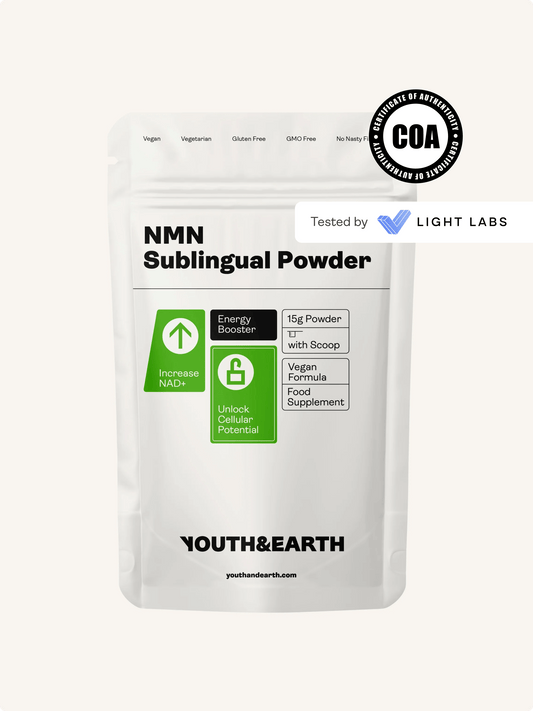
At Youth & Earth, we're committed to setting the standard for quality and transparency in the supplement industry. Our NMN range is rigorously third-party tested for purity, and we make our certificates of analysis available for every batch. We believe you have the right to know exactly what you're putting into your body.
Frequently Asked Questions
What does NMN do?
NMN serves as a direct precursor or building block to NAD+, a vital coenzyme in every cell. By boosting NAD+ levels, NMN may help support cellular energy production, DNA repair, and the function of longevity-regulating proteins like sirtuins.
Is NMN proven to work?
The evidence is clear that NMN is effective at increasing NAD+ levels in humans. Research into how this translates into specific, long-term health outcomes is still emerging, but has shown promising early results in areas like physical performance and metabolic health.
What's the difference between NMN and NAD+?
NMN is the building block; NAD+ is the final, active molecule. NAD+ itself is difficult to supplement with directly because it's a large molecule that isn't easily absorbed by cells. NMN is smaller, more readily absorbed, and your body converts it efficiently into NAD+.
Can NMN help with fatigue and low energy?
Theoretically, yes. Because NAD+ is fundamental to the mitochondrial process that generates ATP, supporting NAD+ levels with NMN may help improve energy metabolism. Many users anecdotally report this effect, but robust clinical trials designed specifically to measure subjective fatigue are still needed.
How much NMN should I take?
Most human studies use doses between 250mg and 1,250mg per day. A common starting point is 250–500mg, usually taken in the morning.
Is NMN safe?
Based on current human clinical trials, NMN appears safe and well-tolerated at commonly studied doses, with no significant adverse effects reported compared to placebo.
What should I take alongside NMN?
For those building a comprehensive supplement stack, compounds like Creatine Chews (for ATP recycling), Liposomal Spermidine (for autophagy) and Mitochondrial CoQ10 (for mitochondrial support) are evidence-led options that may work synergistically with NMN.
DISCLAIMER
The information in this article is for educational purposes only and is not intended as medical advice. Please consult a qualified healthcare professional, such as your GP, before starting any new supplement — particularly if you are pregnant, breastfeeding, or taking other medication.
References
[1] Liao B, Zhao Y, Wang D, Zhang X, Hao X, Hu M. Nicotinamide mononucleotide supplementation enhances aerobic capacity in amateur runners: a randomized, double-blind study. J Int Soc Sports Nutr. 2021;18(1):54. DOI: https://doi.org/10.1186/s12970-021-00442-4
[2] Yoshino M, Yoshino J, Kayser BD, Patti GJ, Franczyk MP, Mills KF, et al. Nicotinamide mononucleotide increases muscle insulin sensitivity in prediabetic women. Science. 2021;372(6547):1224-1229. DOI: https://doi.org/10.1126/science.abe9985
[3] Igarashi M, Nakagawa-Nagahama Y, Miura M, Kashiwabara K, Yaku K, Sawada M, et al. Chronic nicotinamide mononucleotide supplementation elevates blood nicotinamide adenine dinucleotide levels and alters muscle function in healthy older men. NPJ Aging. 2022;8(1):5. DOI: https://doi.org/10.1038/s41514-022-00084-z
[4] Yi L, Maier AB, Tao R, Lin Z, Vaidya A, Pendse S, et al. The efficacy and safety of β-nicotinamide mononucleotide (NMN) supplementation in healthy middle-aged adults: a randomized, multicenter, double-blind, placebo-controlled, parallel-group, dose-dependent clinical trial. Geroscience. 2023;45(1):29-43. DOI: https://doi.org/10.1007/s11357-022-00705-1